
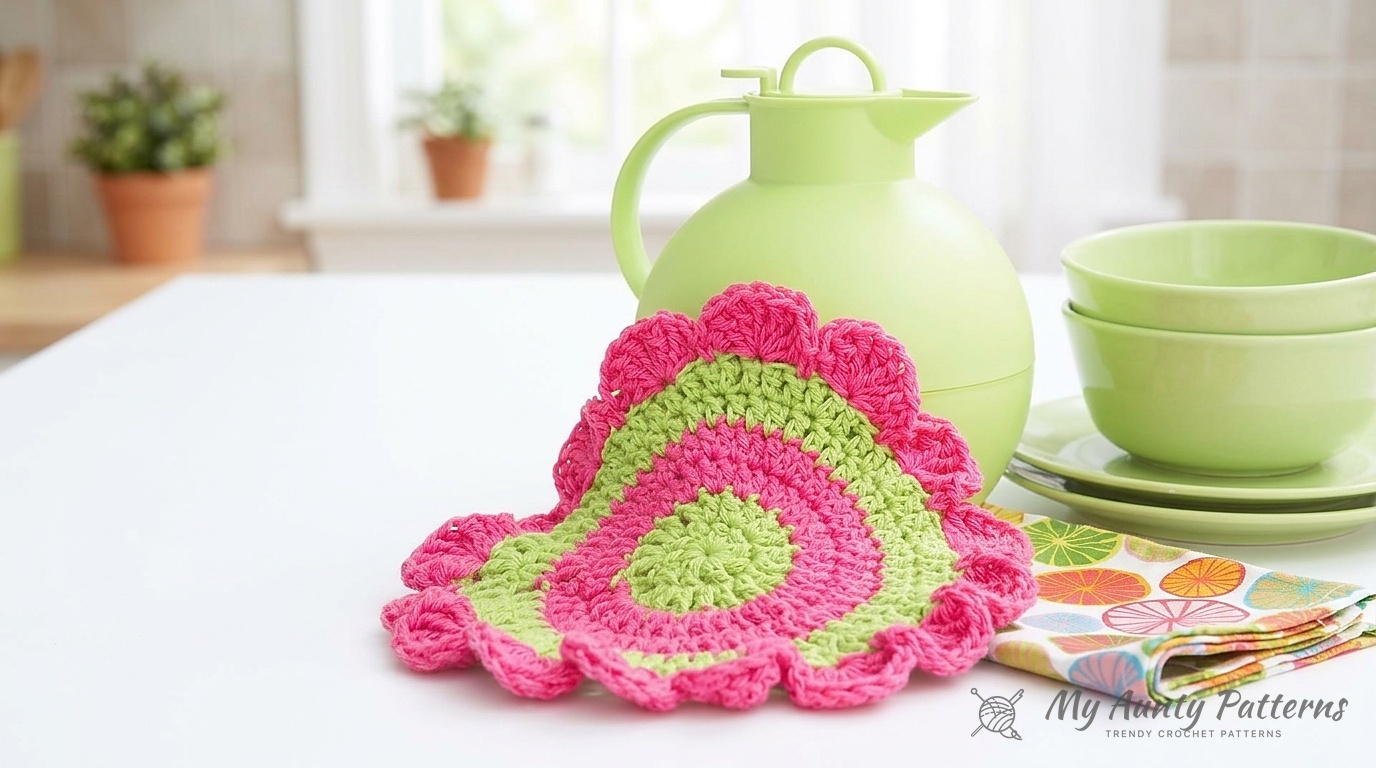
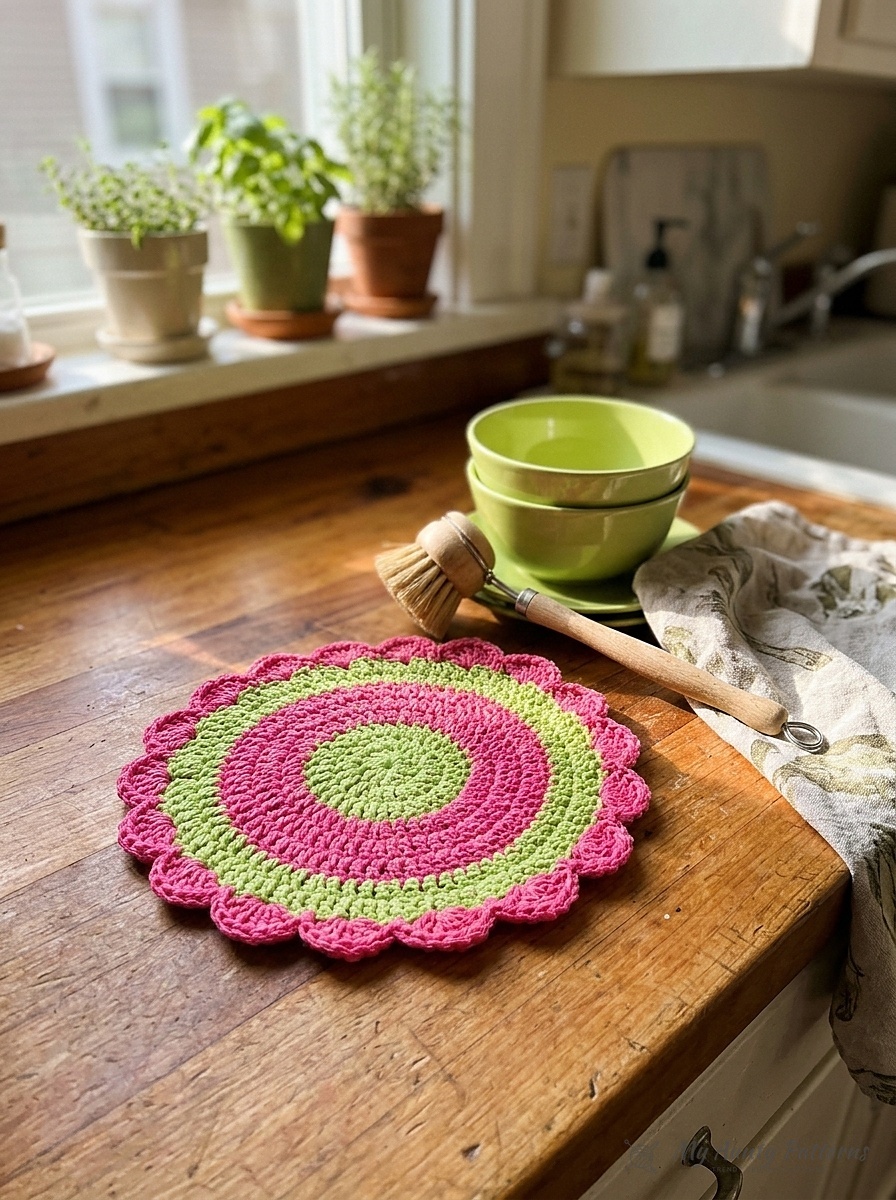
Circular floral dishcloths bring instant cheer to the kitchen sink, and the Daisy Wheel Scalloped Petal Cotton Crochet Dishcloth is one of the fastest 7-round mandalas you can make with scrap cotton yarn. Worked in 100% worsted cotton on a Size U.S. H/8 (5.0 mm) hook, the center builds a flat 6-round wheel that increases by 10 double crochets per round (from 10 dc to 60 dc), then crowns the outer edge on Round 7 with 15 lush 8-treble-crochet (8-tr) daisy petals.
Quick Pattern Specifications
- Skill Level: Easy (6 Flat Dc Increase Rounds + 8-Treble Scallop Petal Edging)
- Yarn Weight: Medium Worsted (#4) — Bernat® Handicrafter® Cotton™ (100% USA Grown Cotton; 1.75 oz / 50 g; 80 yds / 73 m per ball)
- Featured Colorways:
- Contrast A: Hot Green (13722) — 1 ball
- Contrast B: Hot Pink (13712) — 1 ball
- Hook Size: Size U.S. H/8 (5.0 mm) crochet hook (or size needed to obtain gauge)
- Gauge: 13 sc and 14 rows = 4″ [10 cm]
- Finished Measurement: Approx. 9″ [23 cm] diameter across petal tips
How the 15-Petal Daisy Wheel Math Works
Because Round 1 starts with 10 double crochets and Rounds 2 through 6 each add 10 evenly spaced increases, Round 6 finishes with exactly 60 double crochets around the circumference. On Round 7, each daisy petal repeat uses 4 stitches of Round 6: you skip 1 dc, work 8 treble crochets (8 tr) all into the next dc, skip 1 dc, and anchor the petal valley with 1 single crochet (1 sc) in the next dc (60 ÷ 4 = 15 scalloped daisy petals).
Materials & Custom Floral Mandala Size Table
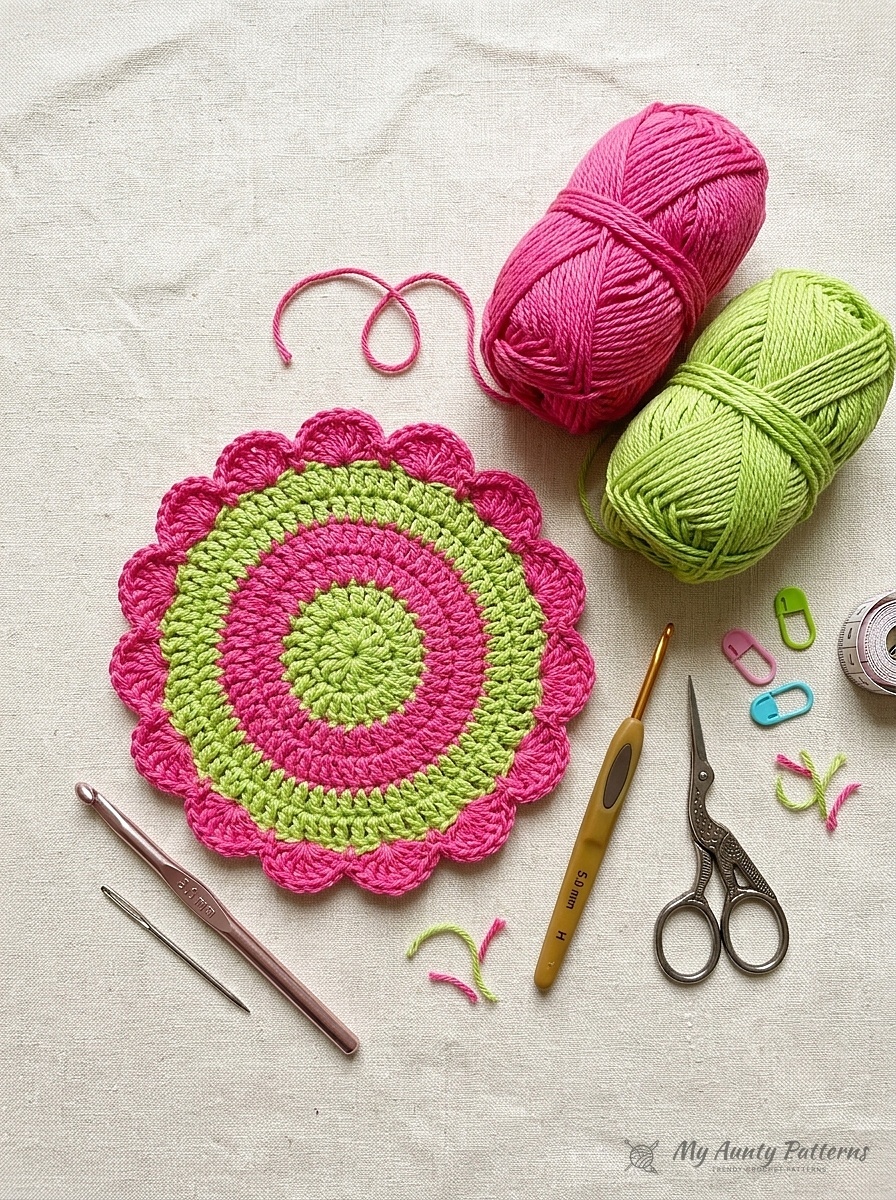
- Yarn: 1 ball each of Bernat® Handicrafter® Cotton™ in Contrast A (Hot Green) and Contrast B (Hot Pink).
- Crochet Hook: Size U.S. H/8 (5.0 mm) crochet hook.
- Notions: Blunt yarn needle and scissors.
| Project Type | Finished Diameter | Center Dc Rounds | Stitches Before Petal Round | Total 8-Tr Daisy Petals |
|---|---|---|---|---|
| Mug Coaster / Facial Round | 6″ [15 cm] | Work Rounds 1–4 | 40 dc | 10 petals |
| Daisy Wheel Dishcloth (Pattern) | 9″ [23 cm] | Work Rounds 1–6 | 60 dc | 15 petals |
| Round Centerpiece / Placemat | 12″ [30.5 cm] | Work Rounds 1–8 (+10 dc/rnd) | 80 dc | 20 petals |
Abbreviations (US Crochet Terms)
- Ch = Chain(s)
- Dc = Double crochet
- Rep = Repeat
- Rnd(s) = Round(s)
- Sc = Single crochet
- Sl st = Slip stitch
- Tr (Treble Crochet) =
(Yoh) twiceand draw up a loop in specified stitch,(yoh and draw through 2 loops on hook) 3 times.
Step-by-Step Crochet Instructions
Note: Ch 2 at the beginning of Rounds 1–6 does not count as a double crochet. Carry the unused yarn color loosely up the wrong side when switching stripes.
Crocheting the 7-Round Daisy Wheel Dishcloth
- Foundation & Round 1 (With Contrast A – Hot Green): Ch 2. Work 10 dc into the 2nd ch from hook. Join with a
sl stto first dc. (10 dc) - Round 2 (Still with A): Ch 2. Work 2 dc in each dc around. Join Contrast B (Hot Pink) with a
sl stto first dc. (20 dc) - Round 3 (With Contrast B – Hot Pink): Ch 2.
*Work 1 dc in next dc. Work 2 dc in next dc.Repeat from*around. Join A with asl stto first dc. (30 dc) - Round 4 (With Contrast A – Hot Green): Ch 2.
*Work 1 dc in each of next 2 dc. Work 2 dc in next dc.Repeat from*around. Join B with asl stto first dc. (40 dc) - Round 5 (With Contrast B – Hot Pink): Ch 2.
*Work 1 dc in each of next 3 dc. Work 2 dc in next dc.Repeat from*around. Do not change color; join with asl stto first dc. (50 dc) - Round 6 (Still with B – Hot Pink): Ch 2.
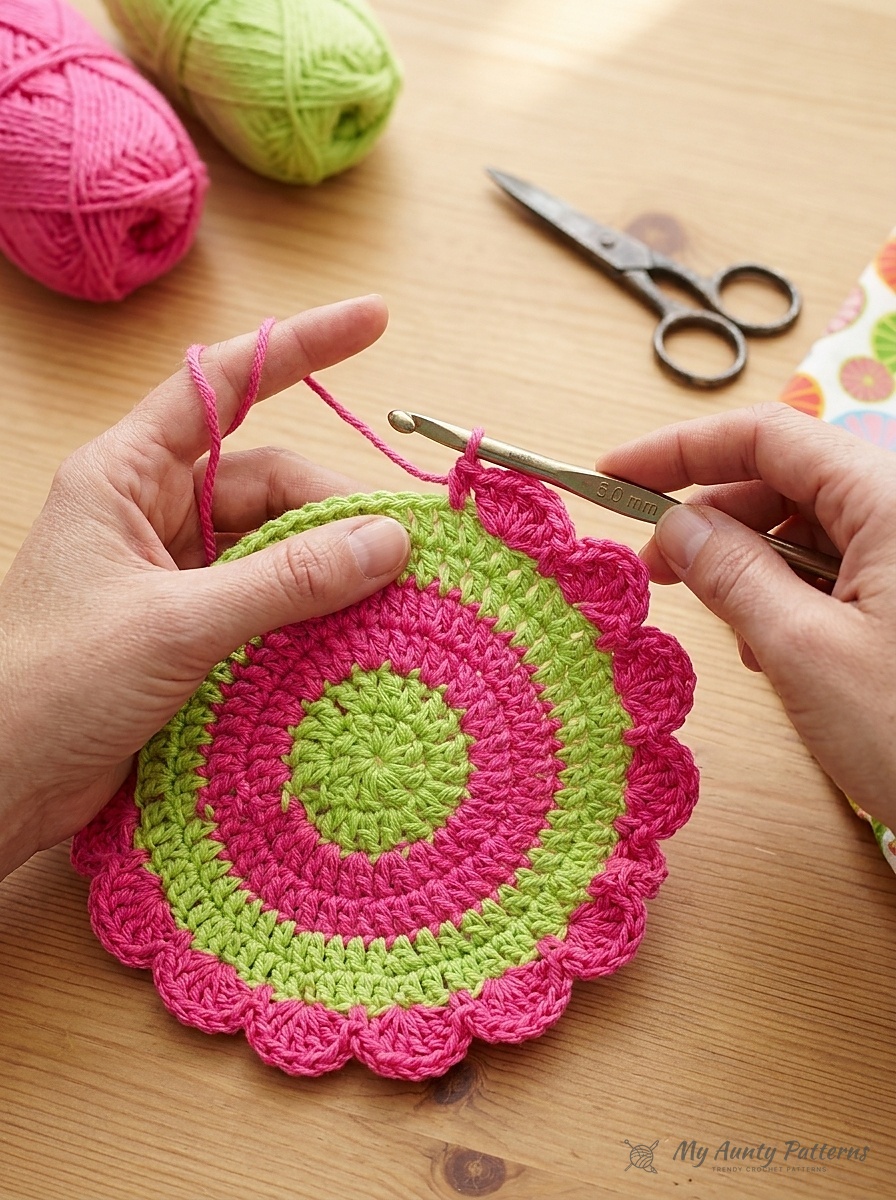
*Work 1 dc in each of next 4 dc. Work 2 dc in next dc.Repeat from*around. Join Contrast A (Hot Green) with asl stto first dc. Break B. (60 dc) - Round 7 (With Contrast A – 15 Scalloped Daisy Petals): Ch 1. Work 1 sc in same space as last sl st.
*Skip next dc. Work 8 tr in next dc (daisy petal made). Skip next dc. Work 1 sc in next dc.Repeat from*around to the last 3 dc. Skip next dc. Work 8 tr in next dc. Skip last dc. Join with asl stto first sc. Fasten off and weave in all cotton ends neatly. (15 scalloped 8-tr petals)
Save & Print This Crochet Pattern
Prefer working offline or keeping a printed copy in your project bag? Download our formatted Daisy Wheel Dishcloth printable PDF guide below, complete with the full materials table, stitch diagrams, color-key charts, and step-by-step assembly instructions prepared for My Aunty Patterns.
READER COMMENTS & PATTERN QUESTIONS
Have a question about stitch counts, yarn substitutions, or sizing? Leave a comment below — Mary Ward reads and replies to every maker question!